

Research
Our research informs the AI component of Robot Learning with Physical and Geometric biases: we specialize in learning Dynamical Systems, Physics-Informed Generative Modeling, and Geometric Robot Learning. A fourth pillar, namely the development of Physics-inspired Optimization Algorithms, enjoys horizontal application including, but not limited to, all topics above.
01
Physical-Geometric Learning & Architectures
Modern learning systems are remarkably expressive, but often require vast amounts of data to discover structure that is already known a priori.
Our research develops architectures that encode physical laws, geometric structure, symmetries, and other domain-specific inductive biases directly into the model and its learning dynamics.
The goal is to make learning more data-efficient, interpretable, and reliable, especially in settings where observations are scarce or expensive to collect.
We use these principles to build compact, structured multimodal world and foundation models that integrate information across perception, dynamics, and action without relying solely on scale.
Rather than treating physical consistency and geometric organization as properties to be learned from scratch, we make them part of the architecture itself.
This provides a principled route toward models that can extract more from limited data, generalize across configurations and environments, and transfer learned representations and behaviors to new tasks.
Ultimately, we seek learning systems whose structure reflects the structure of the physical world.
Research Projects
1.
Contact geometry of dynamical systems, generative models, and optimization
- A. Testa, S. Hauberg, T. Asfour, and L. Rozo. “Contact Wasserstein Geodesics for Non-Conservative Schrödinger Bridges”, Intl. Conf. on Learning Representations (ICLR), 2026.
- A. Testa, S. Hauberg, T. Asfour, and L. Rozo. “Geometric Contact Flows: Contactomorphisms for Dynamics and Control”, Intl. Conf. on Machine Learning (ICML), 2025.
2.
Physics-inspired Robust Visuomotor Policies
We study visuomotor policies that generate actions using structured priors inspired by mechanics, control, and optimal transport. These inductive biases encourage smooth, stable, and contact-aware behavior in robotic manipulation.
The goal is to improve robustness, data efficiency, and generalization beyond purely data-driven policies.
- H. Ding, N. Jaquier, J. Peters, L. Rozo. “Fast and Robust Visuomotor Riemannian Flow Matching Policy“. IEEE Transactions on Robotics (T-Ro), 2025.
- M. Braun, N. Jaquier, L. Rozo, and T. Asfour. “Riemannian Flow Matching Policy for Robot Motion Learning” IEEE International Conference on Intelligent Robots and Systems (IROS), 2024.
3.
Towards Physical Consistency in World Models via Differential Geometry
World models rely on probabilistic generative models evolving in high-dimensional geometric spaces. Applying physics-inspired constraints on the structure of these spaces enables more efficient training and lower computational costs.
4.
Leveraging the geometry of complex dynamical systems for efficient, scalable and explainable learning
Studying novel geometric structures to generalize existing physics-inspired approaches to dynamical systems. Through this perspective, we aim to discover more expressive yet geometrically constrained latent spaces for control, adaptability, and generalization.
02
Uncertainty-aware & Efficient Adaptation Methods
Robot demonstrations are a notoriously scarce modality, and Reinforcement Learning, while not necessitating of historic data, suffers from sim-to-real translation and slow data collection when policies are trained from scratch in the environment.
To this end, endowing Reinforcement and Imitation Learning models and algorithms with strong priors is essential. In particular, such priors need to incorporate concepts from Information Geometry and Classical Mechanics, and are therefore best rooted in their underlying language and structure, that of finite and infinite dimensional Differential Geometry.
Building on top of the latest advances in Applied Mathematics, the Lab develops performant policies that are mathematically shaped for reliability, safety and efficiency.
Alongside this, we develop uncertainty-aware methods that distinguish well-supported predictions from uncertain ones, using uncertainty to direct exploration toward informative or promising regions while supporting risk-aware and safe decision-making.
Finally, we study how physical principles and control-theoretic structure can be embedded as inductive biases within the learning process. By constraining adaptation through known dynamics, invariances, and stability properties, we seek controlled forms of generalization that remain reliable beyond the training distribution, reducing the amount of data and interaction required to adapt to new tasks and environments.
Research Projects
1.
Learning Riemannian Manifolds for Robot Motion Generation
- L. Rozo*, M. Gonzalez-Duque*, N. Jaquier, and S. Hauberg. “Riemann²: Learning Riemannian Submanifolds from Riemannian Data“, in Intl. Conf. on Artificial Intelligence and Statistics (AISTATS), 2025.
- H. Beik-Mohammadi, S. Hauberg, G. Arvanitidis, G. Neumann, and L. Rozo. “Reactive Motion Generation on Learned Riemannian Manifolds“, Intl. Journal of Robotics Research (IJRR), 2023.
- H. Beik-Mohammadi, S. Hauberg, G. Arvanitidis, G. Neumann, and L. Rozo. Learning Riemannian Manifolds for Geodesic Motion Skills, Robotics: Science and Systems (R:SS), 2021. (Best student paper award)
2.
Riemannian Geometry of Reinforcement Learning for Robotics
Reinforcement Learning enjoys deep links with finite and infinite dimensional Differential Geometry. The associated inductive biases allow for training efficient and powerful neural policies.
- H. Ziesche* and L. Rozo*. “Wasserstein Gradient Flows for Optimizing Gaussian Mixture Policies“. Neural Information Processing Systems (NeurIPS), 2023.
03
Safe and Robust AI-driven Control
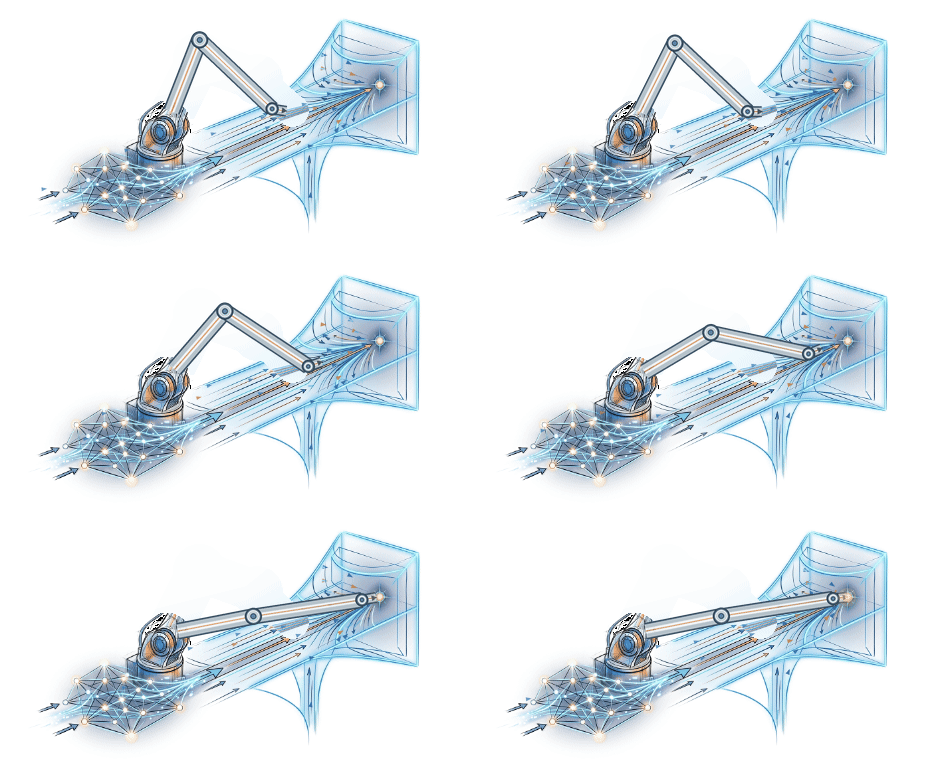
AI-driven controllers are increasingly capable of handling complex decision-making tasks, but their deployment in physical systems requires guarantees that go beyond empirical performance.
Our research develops control methodologies that combine learning with rigorous notions of safety, stability, and robustness.
We investigate how control-theoretic safety constraints and bounds can be incorporated into generative models used for planning and control, so that generated trajectories and actions remain compatible with system requirements.
In parallel, we study how stability properties can be embedded directly into learning-based controllers, providing guarantees on their behavior even when operating under uncertainty, disturbances, or distribution shifts.
A further research direction is the use of differential geometry to analyze and design stochastic controllers. Geometric tools provide a natural language for describing nonlinear state spaces, stochastic dynamics, and structured control laws, and can reveal properties that are difficult to capture in standard Euclidean formulations.
By combining these perspectives, we aim to build AI-driven control systems that are expressive and adaptive while remaining mathematically grounded, predictable, and safe.
Research Projects
1.
Neural Contractive Dynamical Systems
Papers:
- H. Beik-Mohammadi, S. Hauberg, G. Arvanitidis, G. Neumann, and L. Rozo. “Extended Neural Contractive Dynamical Systems: On Multiple Tasks and Riemannian Safety Regions“, Intl. Journal of Robotics Research (IJRR), 2026.
- K. Simmoteit, P. Schillinger, and L. Rozo. “Diffeomorphic Obstacle Avoidance for Contractive Dynamical Systems via Implicit Representations“, Robotics: Science and Systems (R:SS), 2025.
- H. Beik-Mohammadi, S. Hauberg, G. Arvanitidis, N. Figueroa, G. Neumann, and L. Rozo. “Neural Contractive Dynamical Systems“, Intl. Conference on Learning Representations (ICLR), 2024. (Spotlight)
2.
Dynamical Systems Flows with Stability Guarantees
- R Pérez-Dattari, F Leiva, A Testa, L Rozo, JR del Solar, N Jaquier. Let the Dynamics Flow: Stable Flow Matching Dynamical Systems. arXiv, 2026.
- J. Zhang, H. Beik-Mohammadi, and L. Rozo. “Learning Riemannian Stable Dynamical Systems via Diffeomorphisms”. Conference on Robot Learning (CoRL), 2022.